

Publishing Technology Trends: beyond articles
Monday, January 14, 2008
(This posting reviews a presentation entitled "Beyond Articles: non-standard publishing" given by Toby Green, OECD's Head of Publishing, at the Publishing Technology Trends event held in London in December 2007).
In this digital era, argues Toby Green, publishers should be doing a lot more with content than simply posting it online in static, print-inherited formats. And sure, we've made some concessions to the additional functionality offered by online publishing (e.g. interlinking articles with DOIs), but generally the content being linked is still static and two-dimensional. Users may expect scholarly articles to adhere to a fairly dry, traditional format - but we can begin to introduce data and functionality around them that have no need of such restrictions. A table within an article could link to a spreadsheet of the full dataset. This in turn could link to an entire database - giving the user the opportunity to manipulate existing data in pursuit of their own research goals. And the loop could be closed with a further link - "do you want to see analysis of this data?" - back to the original article.
The Center for Global Development is taking just such a progressive approach to its data with web services like its Commitment to Development Index. Clean, contemporary visualisation is combined with mouse-over functionality to enable users to interact easily and effectively with datasets that in their raw form would be dauntingly dense.
The appeal - and potential - of this approach is demonstrated by the success of Gapminder ("taking information that's 'dry as dust' and making it visible through animation. Making sense of the world by having fun with statistics!"), which which was snapped up by Google last March. In allowing users to quickly and easily access and compare data sets it enables powerful penetration of that data to reveal otherwise unheeded truths - for example, comparing time periods, countries and mortality rates in its simple interface highlights reduced life expectancy in post-AIDS Botswana.
A final example, Seed Magazine's Science in Silico, harnesses the greater flexibility of online publishing formats to publish messages which simply could not be communicated in traditional two-dimensional formats.
OECD is responding to this vision of multi-dimensional data as it develops its publishing platform. The organisation is also collaborating with CrossRef to expand the types of data that can be deposited to CrossRef and thus cited independently of the articles to which it relates.
Toby's session prompted a number of questions from the audience, ranging from restrictions that apply to DOI application (currently, submission to CrossRef requires metadata to be supplied in a schema designed for journals) to the business models under which additional data could be made available to users (OECD's is, effectively, free to subscribers) and the copyright/IP concerns of publishing data that has been produced within a research institution.
Labels: "center for global development", "commitment to development", "publishing technology", "science in silico", articles, copyright publishing, gapminder, oecd
posted by Charlie Rapple at 9:42 am


You've been Scribd
Monday, April 02, 2007
Following onto Leigh's posting about Scribd, and an older posting of mine about academic papers on iTunes, I'm following up with another Scribd posting - having been alerted to some slightly alarming content within the site by Rafael Sidi over on Really Simple Sidi.
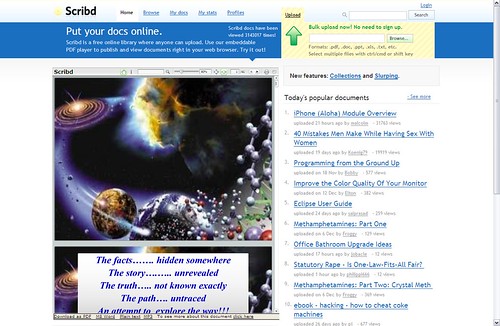
Scribd, you may remember, is "a big online library where anyone can upload" and which "lets you publish and discover documents online". So far, so legal. However, as other industries have found (Sidi cited You Tube, of course, and one might equally obviously suggest Napster), you cannot supply users with sharing tools and expect them to observe, of their own volition, such niceties as copyright. Noting, deep within the FAQ, that "copyrighted content you don't own may not be uploaded" is inadequate.
Lo and behold, amongst the detritus, Scribd is already bubbling with copyright material being made freely available. Sidi, an Elsevier employee, cites a couple of examples from their publications, to which one might add this AIP example, this from Macmillan's Encyclopedia of Energy, this from the Ecological Society of America and this from the Linguistic Society of America, both via JSTOR ... and so on. The most alarming thing about the JSTOR examples is that they must (due to JSTOR's business model) have been accessed by users within an institution - users whose librarians will of course be tearing their hair out about this misappropriation of licensed content. And it is particularly galling that the AIP example includes a clear message ("this article may be downloaded for personal use only") which the user has either misunderstood or simply ignored.
Of course, it might be that all the articles I have found have been posted by authors with self-archiving permissions (do these tend to allow for posting on a site like Scribd? or might they only allow for self-archiving on one's own site, or one's own institution's repository?). But even if publishers do allow self-archiving on any chosen site, I believe authors are often restricted to archiving a pre-print (which none of the above are) - and one thing I *can* say categorically is that no publisher permits authors to archive the JSTOR version, so I would suggest the JSTOR examples above are clearly posted illegally - not necessarily by the author, of course.
Scribd full text is indexed by "Google and other major search engines", so it's certainly going to be as discoverable if not, one would hope, as highly-ranked, as the publishers' own sites. If the site takes off, therefore, publishers - like the entertainment industry before them - will need to rely on user understanding of, and adherence to, copyright law, or end up in a position where revenue streams (particularly single article sales) are threatened by centralised, free availability of copyright content. Of course, publishers could recourse to legal action - as they are doing in several other cases where they believe copyright and fair use are being undermined (think AAP v Google) - but, again, the music industry has a bit of a nasty precedent there. It is today, after all, that EMI has decided to give up and withdraw DRM from its iTunes content - i.e., music publishers have realised that getting Joe Average User to adhere to copyright law is just not happening.
Now, Scribd is not, of course, the downfall of copyright and scholarly publishing as we know it. But it's a nice site, with adequate functionality (as Leigh noted, for example, the PDF viewer is nice) - and 3 million documents viewed in less than a month since its launch is not to be sniffed at in terms of its findability, useability and, of course, quantity/quality of content. Users are discovering this site, and they are accessing content on it that - in some cases at least - should rightfully be accessed elsewhere. It will be interesting to keep track of the site's usage (both in terms of what's being posted, and how high its traffic is) - and to see how those publishers whose material is being pirated react.
Scribd, you may remember, is "a big online library where anyone can upload" and which "lets you publish and discover documents online". So far, so legal. However, as other industries have found (Sidi cited You Tube, of course, and one might equally obviously suggest Napster), you cannot supply users with sharing tools and expect them to observe, of their own volition, such niceties as copyright. Noting, deep within the FAQ, that "copyrighted content you don't own may not be uploaded" is inadequate.
Lo and behold, amongst the detritus, Scribd is already bubbling with copyright material being made freely available. Sidi, an Elsevier employee, cites a couple of examples from their publications, to which one might add this AIP example, this from Macmillan's Encyclopedia of Energy, this from the Ecological Society of America and this from the Linguistic Society of America, both via JSTOR ... and so on. The most alarming thing about the JSTOR examples is that they must (due to JSTOR's business model) have been accessed by users within an institution - users whose librarians will of course be tearing their hair out about this misappropriation of licensed content. And it is particularly galling that the AIP example includes a clear message ("this article may be downloaded for personal use only") which the user has either misunderstood or simply ignored.
Of course, it might be that all the articles I have found have been posted by authors with self-archiving permissions (do these tend to allow for posting on a site like Scribd? or might they only allow for self-archiving on one's own site, or one's own institution's repository?). But even if publishers do allow self-archiving on any chosen site, I believe authors are often restricted to archiving a pre-print (which none of the above are) - and one thing I *can* say categorically is that no publisher permits authors to archive the JSTOR version, so I would suggest the JSTOR examples above are clearly posted illegally - not necessarily by the author, of course.
Scribd full text is indexed by "Google and other major search engines", so it's certainly going to be as discoverable if not, one would hope, as highly-ranked, as the publishers' own sites. If the site takes off, therefore, publishers - like the entertainment industry before them - will need to rely on user understanding of, and adherence to, copyright law, or end up in a position where revenue streams (particularly single article sales) are threatened by centralised, free availability of copyright content. Of course, publishers could recourse to legal action - as they are doing in several other cases where they believe copyright and fair use are being undermined (think AAP v Google) - but, again, the music industry has a bit of a nasty precedent there. It is today, after all, that EMI has decided to give up and withdraw DRM from its iTunes content - i.e., music publishers have realised that getting Joe Average User to adhere to copyright law is just not happening.
Now, Scribd is not, of course, the downfall of copyright and scholarly publishing as we know it. But it's a nice site, with adequate functionality (as Leigh noted, for example, the PDF viewer is nice) - and 3 million documents viewed in less than a month since its launch is not to be sniffed at in terms of its findability, useability and, of course, quantity/quality of content. Users are discovering this site, and they are accessing content on it that - in some cases at least - should rightfully be accessed elsewhere. It will be interesting to keep track of the site's usage (both in terms of what's being posted, and how high its traffic is) - and to see how those publishers whose material is being pirated react.
Screenshot of the Scribd homepage, showing its identikit Web 2.0 design and some of today's popular documents (themselves demonstrating the varied quality of the content uploaded)
Labels: copyright publishing
posted by Charlie Rapple at 1:26 pm
 Subscribe to this site
